What We Do
River Herring populations had declined sharply in the early 2000s. As a result, in 2006 the Massachusetts Division of Marine Fisheries implemented a ban on the harvest of herring. While the harvest ban was intended to reduce one stress on these fish they still faced a series of threats including drought, changing climate, shifts in predation, and an inability to get to their spawning grounds due to dams or non-operational fish ladders. Herring are a crucial link in the coastal food chain, as a source of food for striped bass, bluefish, osprey, herons and other coastal species. Following the harvest ban many rivers saw increasing numbers from 2012 to 2019. Unfortunately, declining and unstable runs were seen from 2020 to 2022. In 2023 and 2024 many runs bounced back strongly, include Herring Brook in Pembroke!
To help combat these problems, the North and South Rivers Watershed Association and MassBays National Estuary Partnership is seeks volunteers each year from the end of March through the end of May to count herring. The counting is done in 10-minute blocks, seven days a week, six to nine times a day, at up to seven different locations. These counts will help us continue to monitor trends in our local herring population. We will also be able to verify that herring can now pass dam removal sites on Third Herring Brook and Bound Brook.
 2025 Raw Counts (& Peak Count in Last 10 Years)
Bound Brook – 0 (4 – 2020)
First Herring Brook – 16 (40 – 2021)
Third Herring Brook – 0 (location has varied over time as a result of dam removals)
South River – 257 (257 – 2025)
Herring Brook – 15,578 (15,578 – 2025)
Following the strong runs in 2023 and 2024 volunteer counts remained high at the most successful run, Herring Brook in Pembroke. This site is monitored by volunteers as well as an electronic counter. Based on the electronic counter data, Herring Brook was one of the largest run in the state with almost a half million fish passing up the ladder.

Our volunteers count river herring at multiple locations to track herring populations. Volunteers are needed that can commit to doing 10 minute counts, ideally several times a week, during a specific time period, at one of the sites. The sites are:
- Bound Brook, North Scituate – site of a 2017 dam removal, herring have only just started to return in small numbers.
- First Herring Brook, Scituate – We documented the consistent presence of herring here in 2024 and 2025. We’re hoping that the winters snows translate to good spring flows.
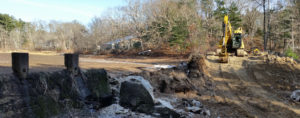
- South River, Marshfield – Dam removal is complete! Fish passage in 2026 will be up the newly constructed channel. This will be our first chance to evaluate restoration success!
- Herring Brook, Pembroke – Historically the highest population of herring in the watershed, it is a crucial site for tracking trends.
- Island Creek Duxbury – New to our program. Used by Native Americans. The Island Creek Pond is 35-acres and has a stream flowing two miles into Kingston Bay thru the 7-acre Mill Pond over two fish ladders built in 2017, One ladder is in the stream near the IC Pond. The other at Rt. 3A. This run has been stocked for the past four years with herring from the Pembroke run.
- Note that we are pausing the Third Herring Brook count this year. We will be using some innovative new tools to look for fish in this system.
The time slots will be between 7 am and 7 pm.
Several in-person training sessions will be held for new volunteers. These will be held at multiple locations. However, the methods are generic to all sites so you can attend any training regardless of the site you have registered to count. Training sign-ups are included on the sign-up page. We will also post on-line training information as we get closer to the start of the counts.
Please join us in collecting important data that helps inform restoration in our watershed and helps us understand herring populations locally and regionally.