 This spring, environmental advocates across Massachusetts have been working to find balance between growth and housing needs and the protection of our natural resources.
Mass Ready Act
The Senate passed its version of the Mass Ready Act (S.3064) in mid-April and that will now move to the House for review. Also known as the Environmental Bond Bill, this piece of legislation will authorize funding for environmental projects over the next 5 years and proposes supporting policy initiatives. We were happy to see that the Senate version included a provision to address drought management (section 2B) – akin to the Drought Bill which NSRWA has supported for many years – but there are areas of concern.
The Senate proposed a few sections that could weaken local wetland bylaws in order to to fast-track priority housing. NSRWA has joined other environmental advocates in submitting a letter to the House Committee on Ways & Means and we encourage you to reach out to your Representatives today and ask them to oppose these anti-wetland and anti-clean water sections. Click here to find your Representative’s contact information and see the bottom of this page for a draft email.
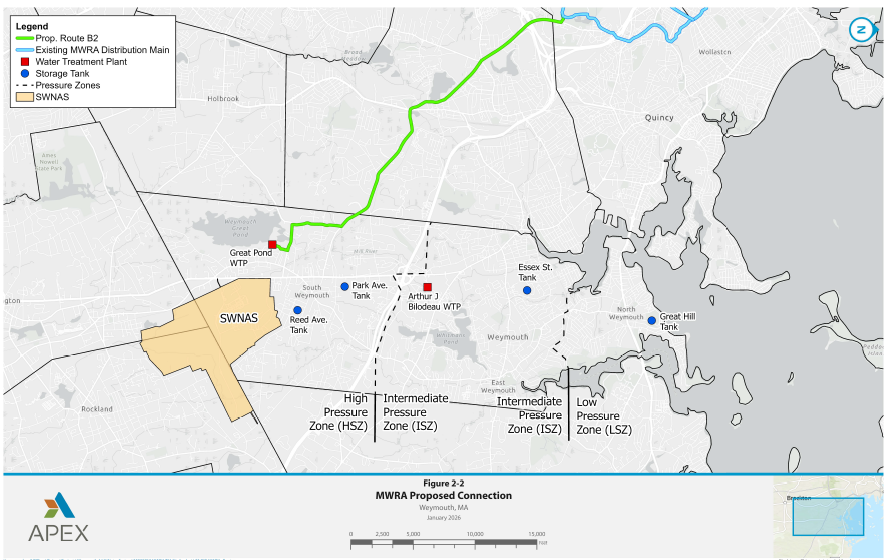 MWRA Transmission Route to Weymouth
Earlier this month, NSRWA submitted comments on the Draft Environmental Impact Report (DEIR) for the proposed connection of the Town of Weymouth and the Southfield Redevelopment Authority to the MWRA water system. This report focuses strictly on the physical pipeline route—the actual approval to transfer water out of the MWRA system will come later through the Interbasin Transfer Act review process.
NSRWA was pleased to see a number of our previous comments addressed in the DEIR. The report includes provisions for a Water Conservation Plan, Drought Management Plan and Administrative Consent Order with MassDEP to lower unaccounted for water to 10%. It also calls for the decommissioning of current water supply sources which will provide much-needed relief for the Back River watershed.
With that said, we are concerned that the capacity of the selected transmission route may not be sufficient to meet future regional demand while also maintaining necessary streamflows and mitigating long-term impacts to local water resources. Expanding MWRA to the South Shore is a critical, one-time opportunity that requires a definitive, long-term solution. The route selected for this project must consider whether the capacity is enough for everyone in the region, including ecological restoration and relief for our waterways.
NSRWA’s letter also addressed the need for a clear funding pathway for this $132 million project. Additionally, we urged officials to consider the impacts of a recent proposal to divert 350,000 gallons per day from the Brockton Desalination Plant to Rockland. This diversion would support Rockland’s drinking water supply and the redevelopment of the South Weymouth Naval Air Station.
The decisions made in the coming months will shape the health of our local watersheds for decades to come. Thank you for standing with us to protect our waters.
Draft Email for Legislators
Dear Representative [Name]
My name is ___________ and I am a resident of ___________. I am writing to request that you oppose Sections 60, 68, 69 and 108 of S.3064, An Act to build resilience for Massachusetts communities. These sections are in conflict with this bill’s purpose of investing in clean water and safe, climate resilient communities.
These provisions were added during the Senate vote as a way to streamline priority housing yet they will effectively endanger residents of that housing and the larger community by creating new and avoidable risks of flooding, pollution, and contaminated waterways by eliminating existing local protections.
The following sections should be removed from the House version:
• Section 60, Section 68 (lines 2630-2640), and Section 69 (lines 2687-2692) – together, amendment 264 in the Senate – exempt priority housing from local wastewater and wetlands bylaws that exceed the requirements of the state regulations under Title 5 and the Wetlands Protection Act. These provisions create a false conflict between development of much-needed housing and the protection of water supplies and flood risk management.
• Section 108 (Senate amendment 267) would condition access to all state grant funding under the bond on municipalities adopting “non-restrictive” zoning and land use policies, including wastewater and wetlands regulations, that do not exceed state minimum standards. By creating a financial incentive to weaken local water protections, this amendment would force communities to choose between critical, and already limited, public funding and the health of their water supplies, rivers, lakes, and estuaries.
Safe, resilient, and sustainable housing depends on clean water, effective wastewater management, and protection from flooding and stormwater impacts. We strongly recommend that the House version of Mass Ready remove these harmful provisions and uphold the ability of municipalities to protect their water resources and prevent flood risks.
Thank you for your attention to this matter and for your continued efforts to protect our waters.
Sincerely,
[Your Name]
[Your Address]
[Your Organization, if applicable]