
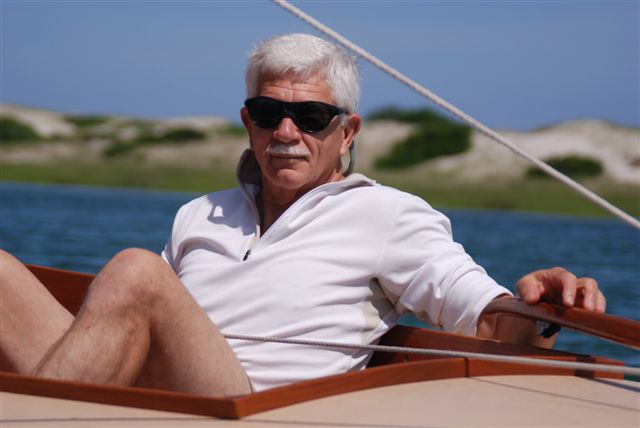
Roger Crawford’s link to local maritime history is deep. Having eight ancestors aboard the Mayflower on one side of his family and ties to Nova Scotian settlers in 1638 on the other side, Roger is embedded in nautical culture. While growing up in Milton he had access to a variety of small craft from runabouts to canoes and rowing boats. As he puts it: “We always had them, and I was always in them.”
His love of boats and the ocean led him to surfing where his skills became good enough that he surfed for the local Hobie Competition Surf Team in East Coast contests and championship events. His surfing career soon found him managing five Hobie surf shops across New England and later spending winters surfing and sailing in the Caribbean. But after that stint, he found himself back on the South Shore and out of work after losing his part-time sales job at Green Harbor Marina due to the fuel crisis of 1973.
Opportunity Knocks
At the time, Roger had a surfing friend who was building beautiful small sport fishing boats but struggling with the business to the point that they were down to their last built boat, which they needed to sell to keep the company alive. Roger felt confident enough in his sales skills that he said he would work at the upcoming Boston boat show for nothing, and if he sold the boat, he’d settle for a 5% commission. In fact, he sold three boats at the show and suddenly the company was back in business. Despite that success, his commission depended on the boats being built and delivered. His friend was an incredibly talented boat builder but meticulously slow, so Roger asked if he could help in the shop to speed up the process.
“I’d been messing around with boats all my life. So, I said, “Can I help you with this?” I started working in the shop basically for nothing with the goal being that when we deliver the boat I would get paid. In the meantime, I continued to sell more boats but soon found that the most reward was in helping build the boats.”
It turned out that all his efforts couldn’t save the company. He could see it failing and that his friend was struggling emotionally with the pressure. Eventually his friend walked away, and the other partner bailed out leaving Roger to try and save the business over the next several months. While all this was going on, Roger’s interest in building boats grew, but the business was now doomed to fail so he asked his friend if he would sell him the molds for a 16’ Swampscott Dory, thinking he might start building boats on his own.
Bootstrapping The Start
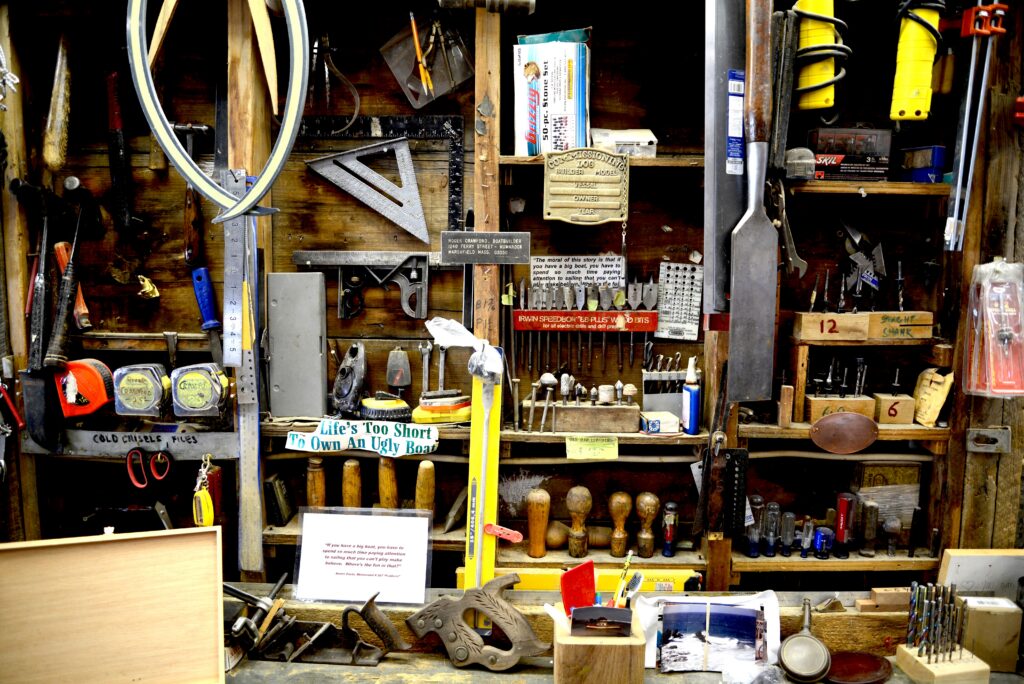
Roger had found his passion, but all he had was a single mold and no money. Despite the headwinds, he went to a bank and got a $3,000 loan. The next challenge was looking for a place in which to build his boats. He wanted a shop on the coastline and found a suitable building diagonally across the street from his current Ferry Street, Marshfield location. After he located the owner and struck a deal to pay $125 a month, he bought some tools and materials and started building his first boat on April 1, 1976.
The mold that Roger had purchased was for a classic 18th century working boat, a 16’ Swampscott Dory, which his friend had designed as a rowing and motor boat. Roger began building the boats and later that year when he had one on display at the Newport Boat Show a potential customer told Roger he would buy one if he built it as a sailboat. So, he added a sailing version, and for eleven years he built dories, close to 200 of them.
An Unwanted Job
It was by chance that in 1987 his crafting of historical boats took an unexpected turn. Roger had become well known for his boats and repair work skills, and one day he received a call from a man who said he had an old unfinished boat and asked if Roger would bring it back to life for him. Roger told him he wasn’t doing repair work at that time, but the man kept insisting that Roger at least look at his boat. Roger was equally adamant about not wanting to take on the job but asked what type of boat it was. The man said it was a Melonseed skiff.
“I’ll never forget the moment. This funny little thing went off in the back of my head, and I don’t know why, or if I had even heard the words ‘Melonseed Skiff’ before, but something just clicked in my mind. I had a sharp feeling of momentary curiosity, but I put that away and just said no.”
The boat owner refused to take no for an answer, asking Roger if he would be at the shop the next Saturday, to which Roger fibbed and said no to avoid meeting him. He usually worked Saturdays but that day he stayed away from the shop. He thought that was the end of it until he came back to his shop late that afternoon and found the boat abandoned on his doorstep! Very annoyed, he dragged the boat around the back of his shop and covered it with a tarp. Out of sight, out of mind.
Second Thoughts
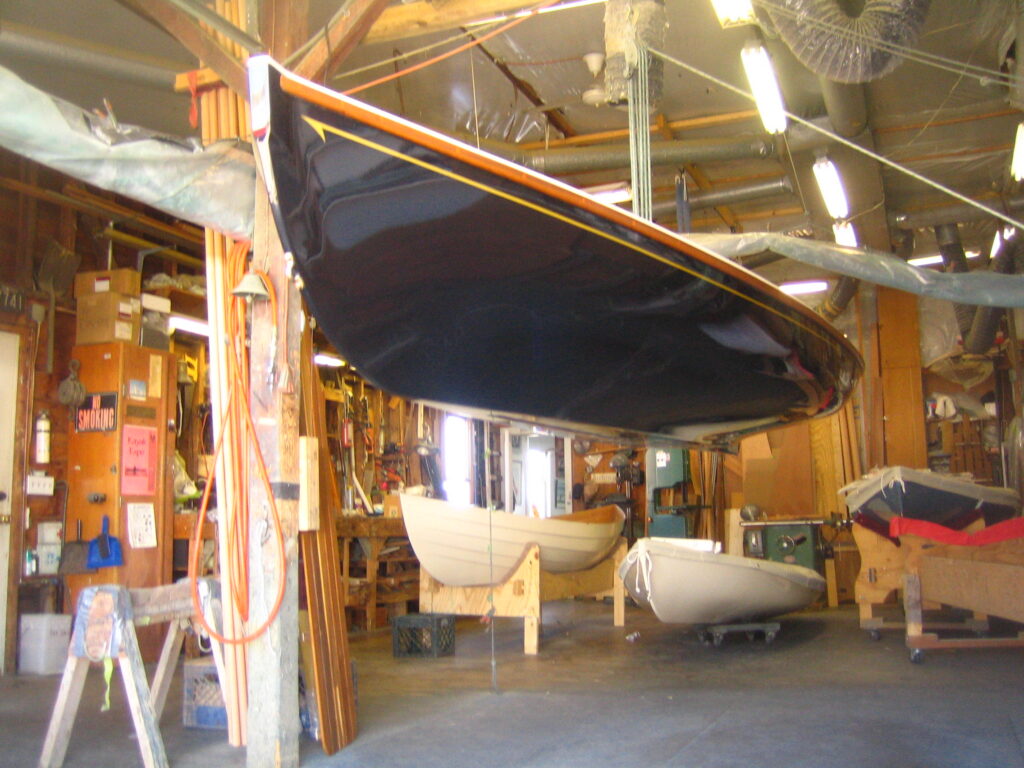
Over the years, Roger’s shop had become one of those places where the local watermen stopped by to talk about boats and catch up on the neighborhood gossip. They kept asking Roger what was under the tarp behind the shop. They would go out and peek under the tarp and quiz him about whether he was planning to work on it or not. He held firm with the sort of a “no” that a curmudgeon would utter. One day, he relented and had a look. His initial reaction was that it was a piece of junk, only half built and in terrible condition, but the more he studied the seductive lines and shape of the hull the more intrigued he became, so he brought it into the shop to take a good look. The more he looked the more he became intrigued. You could call it seduced. He decided to take on the job, much to the chagrin of his team who thought the design would never sell. Nonetheless, Roger rebuilt it and when it was done, he took it out for a sail in Scituate Harbor on a January day with the wind blowing about 25 knots. He saw that the Frostbite Class sailors racing in the harbor were getting knocked down by the wind, but his Melonseed performed beautifully. “It handled those winds, and I knew right then that the boat was really exceptional!”
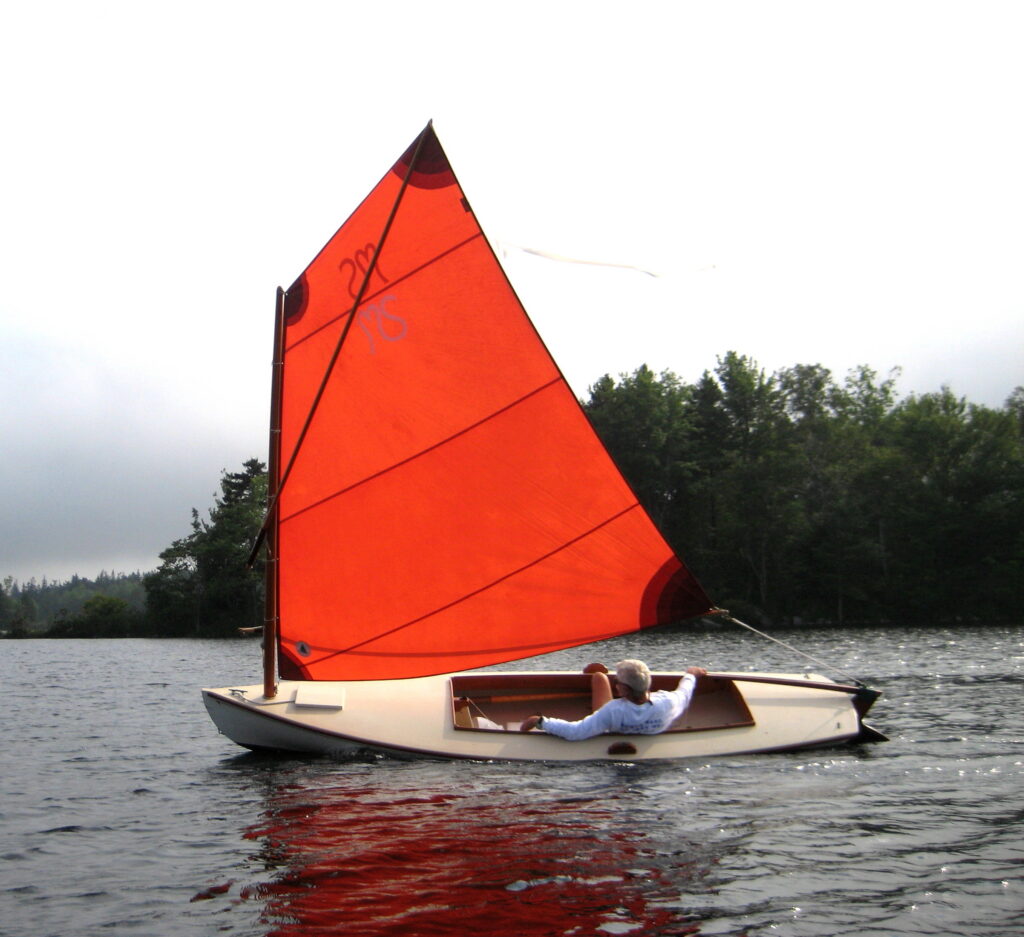
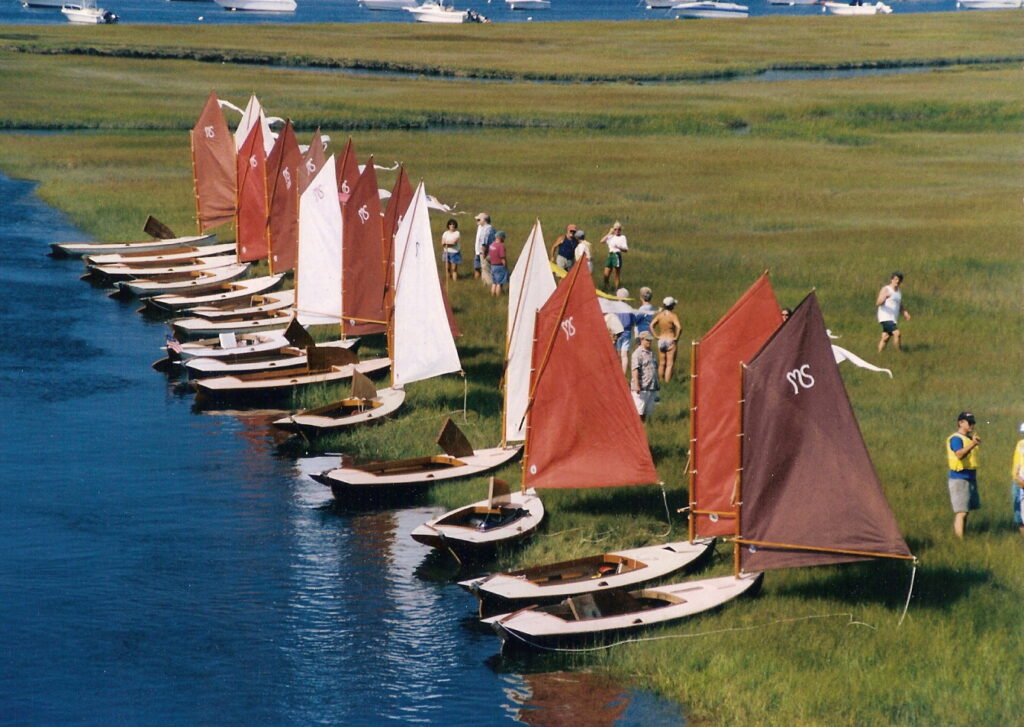
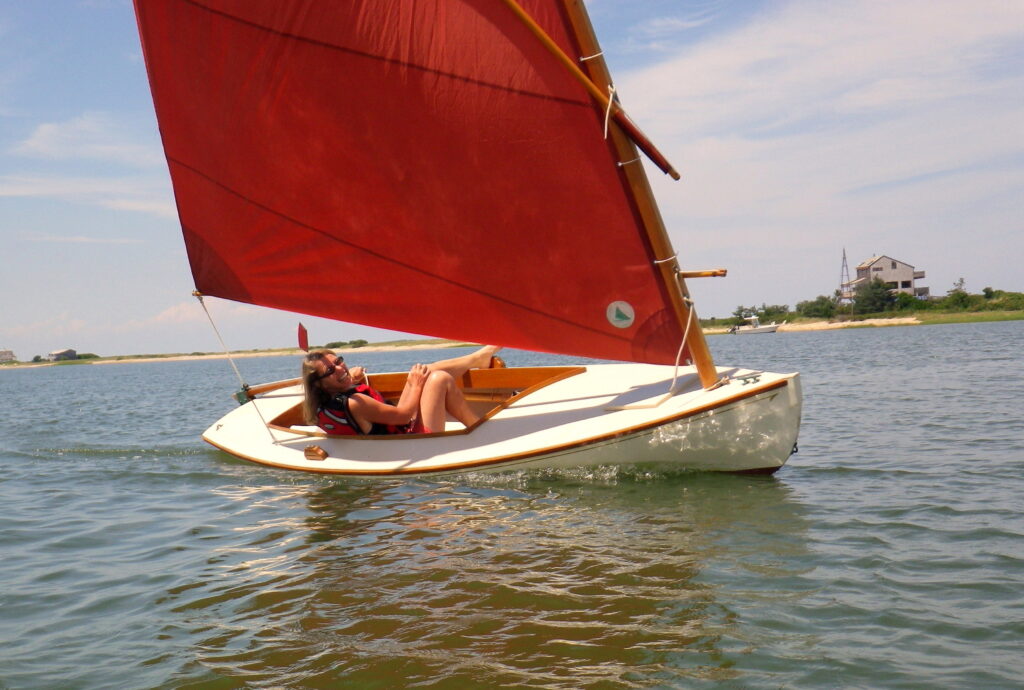
Roger attributes the boat’s handling to its historical design. “It was designed as a basic workboat, a duck hunting boat for use in the Delaware Bay in the 1800’s and falls into a category called gunning boats. The Melonseed was intentionally designed to be an open water boat, yet it could also sneak up a creek or row quite well if necessary and was highly regarded for its capabilities.” Decades have passed but the wind, waves and water haven’t changed, and today the Melonseed still pleases recreational sailors with its performance and beauty. He built 559 of them between 1989 and 2023 when he ceased production! The boats sail in almost all 50 states in the US, Europe, the Caribbean and Hawaii.
Needed to Move
Roger moved his shop across the street to his current location in 1992. He had experienced his share of storms in his original location which was at the lowest point above sea level in the Ferry Street neighborhood across from the South River. Back in the blizzard of 1978, three feet of tidal surge filled the old shop. He had similar issues in Hurricane Bob and the “No Name” storm. Despite being on higher ground in his new home right on the water, he was not to be completely dry. During a storm in the winter of 2018, he found four inches of water in his current shop. His keen awareness of, and decades of experience with dramatic storms on this coastline keep him ever alert of the weather.
It seems fitting that Roger builds his historical boats in a building with a history of its own. It was built in 1926 as the Humarock Ballroom in the “Roaring Twenties”. It still has the original maple dance floor upon which Roger does his work, and the strong post and beam construction that has helped weather storms for all its 100 years of existence.
Historical Legacy
Roger is now the only boatbuilder left on the North and South Rivers where shipbuilding goes back almost four hundred years. His shop is approximately where the Halls and Keene Shipyard and White’s Ferry Shipyard operated in the seventeenth to nineteenth centuries. Further inland along the upper reaches of the North River, dozens of shipyards were also active until the 1870’s. A great many of the ships built upriver were brought down to the area near Roger’s shop to be finished being rigged with the masts and other heavy gear and fitted out before sailing out of the old mouth of the river at Rexhame.
Roger can provide some evidence of the work done long ago.
“If there is a really low minus tide, you can look right down off the back deck of the shop and see old ship’s timbers in the mud. I’ve hauled stuff out of there, timbers, planking and old hardware and chains.”
There was a gap in building boats from the 1870’s until the 1930’s when it started up again. Bob Bowles built speedboats on the location Roger now occupies.
During his 50 years of boat building, working alone or with the help of his small crew, he has built 559 Melonseed Skiffs, 200 Swampscott Dories, 30 Gunning Dories, dozens of small dinghies and yacht tenders, all adding up to over 800 boats.
Proud of the NSRWA
The history of the North and South Rivers matters to Roger, as does their future. He was active in the NSRWA as a member of the Board of Directors for ten years from 2000-2010. With his past boat show experience, he took on running the Association’s Kayak Expo for many years, which was a great place to gain new members. He also led kayaking trips for the Association. He acknowledges how important the Association is in its role as caretakers of the rivers and the watershed.
“I am enormously proud of everything they have accomplished. There aren’t enough words available to tell people how great executive director Samantha Woods and her staff are. Her leadership has been dynamic and successful.”
It Takes Passion
Roger can also be proud of what he has accomplished in keeping alive the historical legacy of the Melonseed Skiff. If you stop by his shop, he will show you the tools he inherited from his father and grandfather that he still uses. If you are lucky, he will have one of his beautiful boats in the shop where you can see and feel the craftsmanship that went into building it.
“Some days I’ll be working in the shop, and the afternoon light will come in the window at just the right angle shining brightly on one of the boats or some freshly varnished woodwork, and even after 50 years I am still awed. You can’t do this without passion. If you are not connected to the romance of boat building, it’s likely you’re never going to succeed. It just won’t work. I am full of gratitude that I’m still able to be here continuing the tradition, yet sad knowing that when I am gone that will be the end of it.”
When Roger closes his shop sometime in the next couple of years, boatbuilding will cease on the rivers after hundreds of years, and surely never return. Until that time comes, he still loves walking through the door every morning and feeling challenged. At 82 years old, his passion for his craft has not waned a bit.