On Monday, June 22nd, we began our annual RiverWatch Water Quality Monitoring program at our 10 long-term monitoring sites on the North and South Rivers. We are so excited to welcome our eight citizen science volunteers and five summer interns! Throughout the summer, we will be posting and reporting our biweekly water quality results on our website, on social media, and in our e-news.
We share this data with the public with a few important caveats; we are not a regulatory agency and these data are only a snapshot of the water quality at the time they were taken. Rain and other polluting events can impact the quality of the water at any time. For example, please take note that these results represent conditions in the morning of June 22nd, prior to rainy conditions on June 23rd. Additionally, the Southeast Region is currently experiencing a Level 2 – Significant Drought, as defined by the Executive Office of Energy and Environmental Affairs. Please visit this link for more information on drought conditions across Massachusetts.
The purpose of the RiverWatch Water Quality Monitoring program, which began in 1994, is to determine whether or not the sites along the North and South Rivers have exceeded bacterial colony concentration numbers for Massachusetts’ swimming and shellfishing standards. We use these data to document the long-term health of our waters, to inform government agencies on the quality of our waters, and advocate for improvements where needed.
Enterococcus samples were collected at ten sites along the North and South Rivers, while fecal coliform samples were collected in five shellfish growing areas (none of which are open at the moment for harvest). According to Massachusetts’ swimming standards, Enterococcus levels may not exceed 104 cfu per 100mL of water sampled. The Mass. Division of Marine Fisheries shellfishing standard is 14 cfu per 100mL of fecal coliform.
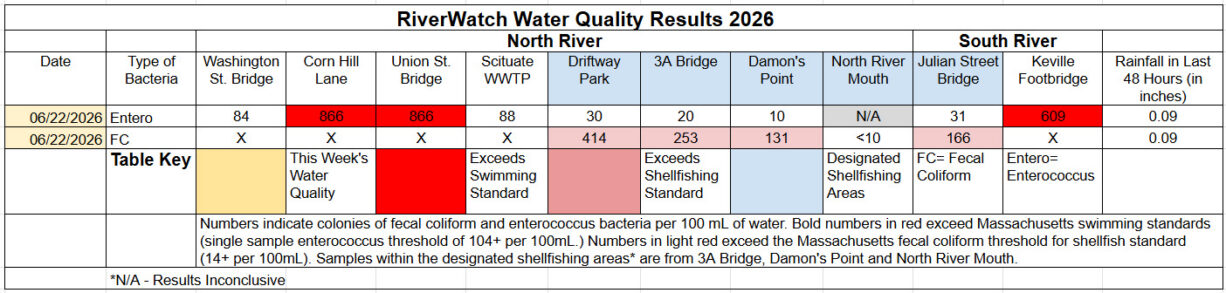
For samples collected on June 22nd, enterococci bacteria levels passed Massachusetts’ swimming standards at 6 of the 10 locations. Corn Hill Lane, Keville Foot Bridge, and the Union Street Bridge exceeded the standards. Results from the North River Mouth were inconclusive.
Additionally, fecal coliform concentrations exceeded the shellfish standard at four sites, including Driftway Park, 3A Bridge, Damon’s Point, and the Julian Street Bridge. Fecal coliform levels passed the shellfish standard at the North River Mouth. However, please note that all shellfish beds in the North and South Rivers are closed from May 31st until November 1st.
This was our first round of sampling for 2026, with our next date set on July 7th. Please check our website and E-news for updated results. Thank you to all of our volunteers this summer for conducting the sampling and analysis, the Cohasset Center for Student Coastal Research for allowing us to use their laboratory for sample processing, and our members for providing funding for this program!