The story of the Third Herring Brook is a prime example of how people have shaped riverine habitat over time, and continue to do so to this day. The brook, which weaves through land first inhabitated by the Massachusett people and now forms the border between Hanover and Norwell, was once replete with fish. During the colonial era, it was dammed for industry, and the river was divided into disconnected fragments that could no longer support the former fish populations. In the 1970s, the course of the river was altered to accommodate the Hanover Mall project, and concrete weirs were installed with the thought of eventually creating pools and fountains alongside the new mall. These served as further impediments to fish passage and natural streamflow.
In the early 2000s, the North and South Rivers Watershed Association set out to make major alterations, once again, to the Third Herring Brook. Except this time, something was different. These alterations were intended to do something that none of the previous ones had: to put the needs of the riverine ecosystem first, to reconnect the fragmented sections, and to restore fish passage.
These efforts were not quick or easy, but ultimately, NSRWA and partners were able to remove every dam and weir on the Third Herring Brook, with the final barriers coming out in 2022. So, what are the results of these decades of river-first work? Did the ecosystem heal? Are the fish coming back? Check out our Third Herring Brook StoryMap to find out more about the history of the brook, the process of restoring it, the results we’ve seen so far, and the next steps we’re taking to help Third Herring Brook heal!
View StoryMap in separate browser window.
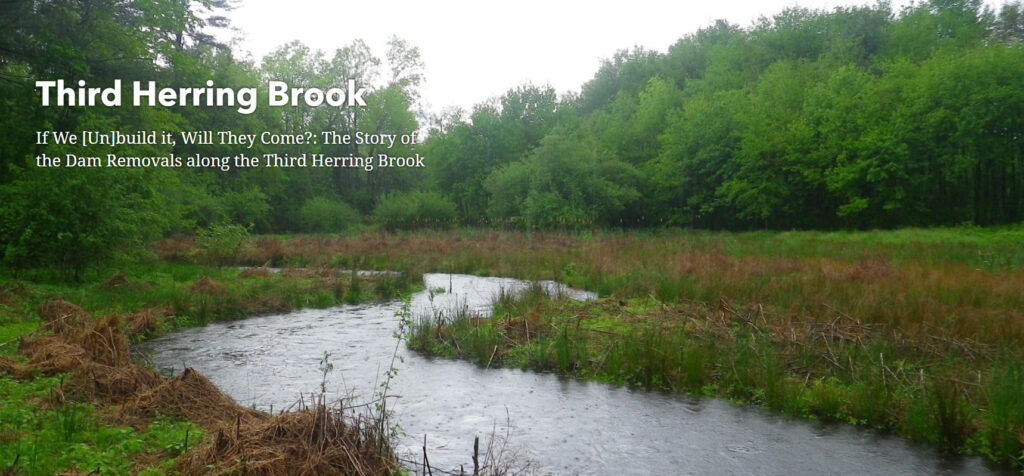
NSRWA’s Third Herring Brook Restoration Project focuses on improving the continuity and streamflow of the Third Herring Brook. Our goal is to restore fish passage for river herring and Eastern brook trout. Over the past eleven years we have completed three dam removals, the removal of two concrete in-stream weirs, and are currently in the final design stages for a fish ladder to access the headwaters at Jacob’s Pond. The removal of the 3 dams on this brook has already led to the return of Eastern Native Brook Trout using the mainstem and the brook being classified as a Coldwater Fish Resource by the Commonwealth of Massachusetts.
A significant challenge that we have encountered is tracking and confirming the presence of the various fish species in the brook following dam removal. The dams created blockages, or choke-points, that backed up fish and made them easy to see. Now that fish have unfettered access throughout the brook, they are hard to find. They naturally avoid predation by moving in the shadows, at night, and through deeply wooded portions of the brook. Traditional methods for finding fish in wild streams include electroshocking, trapping, or even creating new choke-points. These methods are labor intensive and often counter-productive to the very species we seek to restore.
This year we received an award through the MIT Sea Grant STREAM program (Solutions Through Research, Education & Art in Massachusetts). Our project uses environmental DNA (eDNA) sampling as a non-invasive method for identifying target species throughout the brook. Techniques for using eDNA have advanced rapidly in the past decade. They have become more reliable and cost effective. In May and June 2026, we conducted eDNA sampling throughout Third Herring Brook to confirm the presence of River Herring and Eastern Brook Trout up and downstream of the former dam sites. This data will provide critical information to conservation and natural resource managers, and it will also showcase this innovative, non-invasive monitoring approach. The laboratory results are just rolling in now. Stay tuned over the next few weeks as we work up results and see just which fish are in the brook and how far upstream they can now make it.